
If you read nothing else
- C20 means 20 newtons per square millimetre at 28 days. It is a result, not a recipe.
- Water is the enemy. Every extra bucket at the mixer permanently reduces strength.
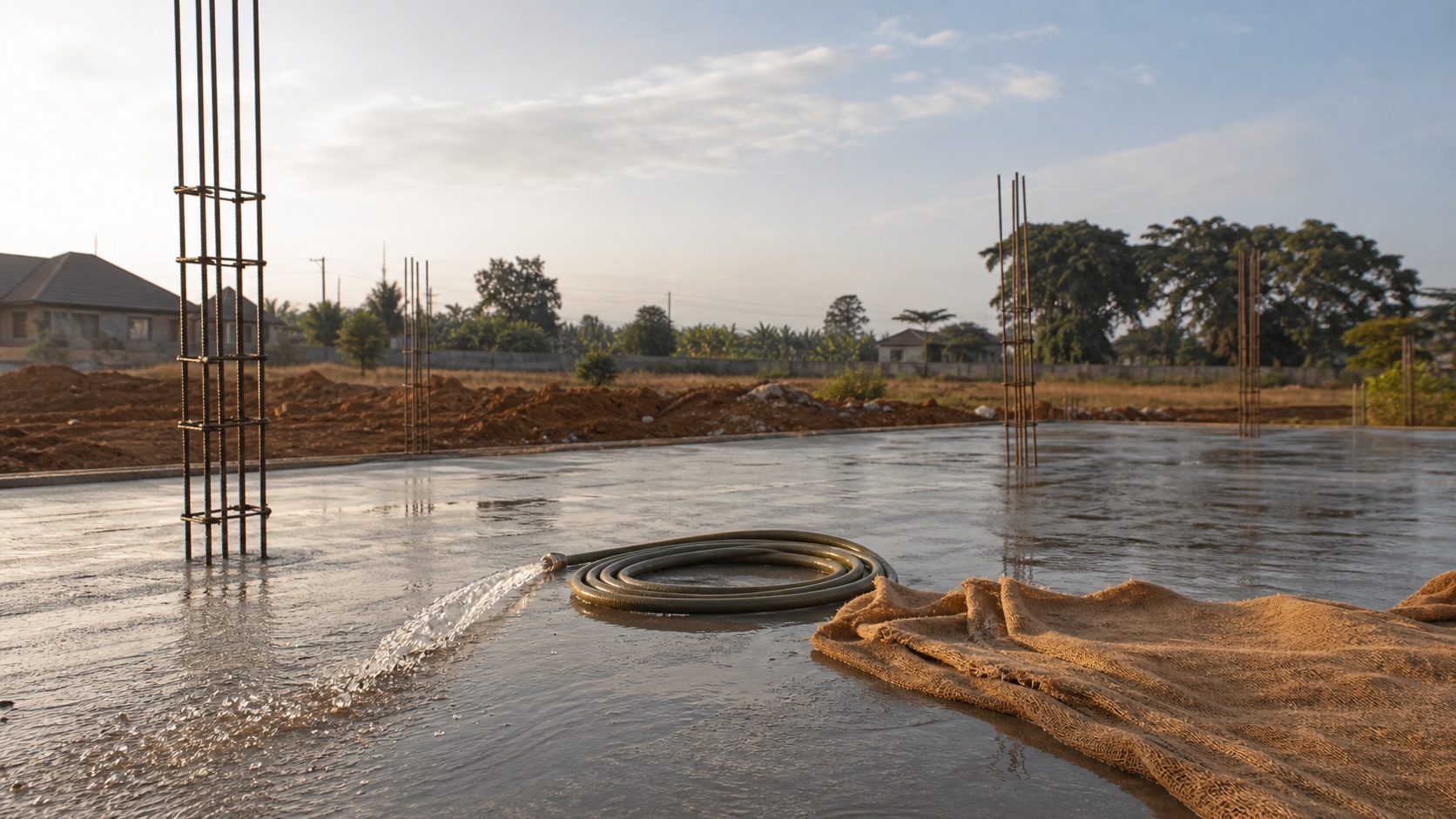
- Curing is free and it is worth up to 40 percent of the final strength.
- Volume batching by wheelbarrow is unreliable. Batch by the bag and count.
- Cube tests cost very little and are the only way to know what you actually got.
- Cement has a shelf life. Do not buy more than about six weeks ahead.
What the grade actually means
When a drawing says C20, it means concrete that reaches a characteristic compressive strength of 20 newtons per square millimetre when a cube of it is crushed at 28 days. It says nothing about what goes into the mix. It is a specification of the result.
That distinction matters because it puts the responsibility in the right place. Nobody is owed a particular mix ratio. What is owed is concrete that reaches the number, and the way to find out whether it did is to crush a cube.
| Grade | Strength at 28 days | Where it is used |
|---|---|---|
| C15 | 15 N/mm² | Blinding under foundations, mass fill, non structural work |
| C20 | 20 N/mm² | Foundations, ground floor slabs, light structural work |
| C25 | 25 N/mm² | Suspended slabs, columns, beams in houses. The common structural grade |
| C30 | 30 N/mm² | Heavier structural elements, apartment frames, water retaining work |
| C35 and above | 35 N/mm² and up | Specified where the design or exposure requires it |
Mix ratios, and why they are only a starting point
Most residential concrete in Kenya is mixed on site to a nominal ratio of cement, sand and ballast by volume. The two ratios in common use are these.
| Ratio | Cement : sand : ballast | Usually aimed at |
|---|---|---|
| 1:3:6 | One part cement, three sand, six ballast | Blinding and mass concrete, roughly C15 |
| 1:2:4 | One part cement, two sand, four ballast | Foundations and slabs, roughly C20 |
| 1:1.5:3 | One part cement, one and a half sand, three ballast | Columns, beams, suspended slabs, roughly C25 |
The word doing the work in that table is roughly. A nominal mix assumes clean, well graded aggregate, sound cement and a controlled amount of water. Change any of those and the same ratio gives a different result.
Water, which decides almost everything
The single largest influence on the strength of concrete is the ratio of water to cement. Not the brand of cement, not the ratio of sand to ballast. The water.
Cement needs a certain amount of water to hydrate. Any water beyond that stays in the mix as free water, and when it eventually evaporates it leaves behind voids. Those voids are permanent, and concrete full of them is weak and porous. As a rough guide, increasing the water content by about ten percent above what is needed can cost you a fifth of the final strength.
The reason it happens is entirely understandable. Wet concrete is easier to shovel, easier to place around reinforcement, and easier to level. Adding water at the mixer makes the day go faster for everyone on site, and the cost of it does not appear for a month.
How to keep it under control
- Fix the water per batch in advance, measure it in a marked drum, and do not let it drift
- Test the slump. It takes two minutes and it is the only objective check available on site
- If the concrete is genuinely too stiff to place, the answer is a plasticiser or a change of aggregate grading, not a bucket of water
- Allow for wet sand. Sand delivered after rain already carries a great deal of water, and the batch needs less
- Never re-temper concrete that has started to stiffen by adding water to it. Discard it
| Element | Typical slump | Note |
|---|---|---|
| Foundations, mass concrete | 25mm to 75mm | Stiff. It does not need to flow |
| Ground floor slabs | 50mm to 100mm | Workable but not soupy |
| Suspended slabs and beams | 75mm to 100mm | Needs to move around reinforcement |
| Columns and congested sections | 100mm to 150mm | Use a plasticiser to get there, not water |
Curing, the free 40 percent
Concrete does not dry, it hydrates. The chemical reaction that turns cement paste into a solid needs water to continue, and it continues for weeks. If the surface dries out in the first few days, that reaction stops near the surface and never restarts. The concrete is left permanently weaker and much more porous than it should have been.
Properly cured concrete can end up substantially stronger than the same concrete left to dry, and the difference is largest exactly where it matters most, in the outer layer that protects the reinforcement from corrosion. Curing costs the price of water and someone's attention. It is the best value available on any site.
What curing means in practice
- Keep the surface continuously damp for at least seven days, and longer in hot weather
- Cover slabs with hessian, sand or polythene and keep it wet. Polythene alone traps the moisture already there and is better than nothing
- Ponding water on a slab is the most reliable method where the falls allow it
- Wrap columns and walls, or spray them repeatedly. A column stripped at one day and left in the sun is the most commonly under cured element on any site
- Continuously means continuously. Wetting once in the morning and again at five is not curing, it is a wetting and drying cycle, which causes its own cracking
The materials themselves
Cement
Cement absorbs moisture from the air and gradually hardens in the bag. A bag with lumps that do not crush easily between finger and thumb has lost strength and should not go into structural concrete. Buy to programme rather than in one large early purchase, keep it off the floor on pallets or timbers, and keep it covered. Six weeks is a reasonable maximum to hold it in Kenyan conditions.
Sand
Sand carrying silt or clay coats the aggregate and stops the cement paste bonding to it. There is a field test that takes fifteen minutes and needs a glass jar. Fill it a third with sand, top up with water, shake it, and leave it to settle for an hour. The silt settles as a distinct layer on top of the sand. If that layer is more than about six percent of the sand depth, the sand needs washing.
Ballast
Oversized ballast leaves voids around reinforcement and forces more cement paste into the mix to fill the gaps. Aggregate should be well graded, meaning a spread of sizes rather than all one size, and the maximum size should suit the section being poured and the spacing of the bars. For most house work, 20mm is right.
Water
Water for concrete should be fit to drink. Water carrying salts, particularly on boreholes in some areas, attacks reinforcement over time. If the borehole water on a site is being used for concrete, it is worth having it tested once.
Cube tests, so you know rather than hope
Everything above is about improving the odds. Cube testing is how you find out what actually happened. It is inexpensive, it is quick, and on any structural pour it should be routine rather than exceptional.
- Take samples from the mix as it is being placed, not from the first or last batch of the day
- Cast six cubes per significant pour, 150mm standard cubes, filled in layers and compacted properly
- Cure the cubes in water, not on a shelf. A cube cured differently from the structure tells you about the cube
- Crush three at 7 days and three at 28 days. The 7 day result is an early warning, typically around two thirds of the 28 day figure
- Keep the certificates. They belong with the house documents, and a future buyer, valuer or bank may ask
If the cubes fail
A low result is not automatically a demolition. It is a trigger for investigation. The sequence is to check the test itself, then take core samples from the structure, then have the engineer assess whether the actual strength is adequate for the actual loads. Sometimes it is. Sometimes the element needs strengthening. Occasionally it has to come out.
Placing and compacting
- Compact with a poker vibrator, inserted vertically and withdrawn slowly, until the surface glistens and bubbles stop rising. Over vibrating separates the mix, so it is possible to overdo it
- Do not use the vibrator to move concrete along the formwork. That separates the aggregate from the paste and leaves weak, stony patches
- Avoid cold joints. If a pour has to stop, stop it at a planned construction joint, not wherever the concrete ran out
- Do not drop concrete more than about 1.5m freely into a column. It separates on the way down. Use a tremie or a chute
- Honeycombing, the open stony patches that appear when formwork is struck, means the concrete did not get compacted around the bars. It is a structural defect where it is deep, not a cosmetic one, and rendering over it hides a problem rather than fixing it
A pour day checklist
- Reinforcement checked against the drawing and cover blocks in place before anything is poured
- Formwork tight, propped, clean and wetted
- Enough cement, sand, ballast and water on site to finish the whole pour without stopping
- Gauge boxes or a counted batching method agreed with the team
- Water measured, not estimated, with a marked drum
- Slump test kit and cube moulds on site
- Vibrator working, plus a spare or a plan if it fails mid pour
- Covering material ready for curing before the pour starts, not fetched afterwards
Questions we get asked
- What is the correct concrete mix ratio in Kenya?
- For structural work in houses, 1:1.5:3 by volume of cement, sand and ballast is commonly used to target C25, and 1:2:4 to target C20 for foundations and ground slabs. Blinding and mass concrete typically use 1:3:6. These are nominal mixes and they only reach those strengths with clean well graded aggregate, sound cement and controlled water.
- What does C20 or C25 concrete mean?
- It is the characteristic compressive strength in newtons per square millimetre measured on a cube at 28 days. C25 concrete reaches 25 N/mm². It describes the result, not the recipe, which is why two sites using the same mix ratio can produce concrete of very different grades.
- How long should concrete be cured in Kenya?
- Keep it continuously damp for at least seven days, and longer in hot dry conditions or where cement replacement materials are used. Curing is worth a large share of the final strength, it costs almost nothing, and it protects the outer layer of concrete that keeps the reinforcement from rusting.
- How long before formwork can be removed?
- As general guidance, column and wall sides can come off after about 24 to 48 hours, beam sides after two to three days, slab soffits after seven to fourteen days, and props under slabs and beams should stay for two to three weeks depending on span and loading. The engineer's figures for your structure take precedence, and striking props early is one of the more dangerous shortcuts on any site.
- Why is my concrete weak?
- In order of likelihood: too much water added at the mixer, no curing or inadequate curing, silty sand, inaccurate batching by wheelbarrow, old or damp cement, and poor compaction. The first two account for most of it, and neither costs anything to put right on the next pour.
- How many cubes should be tested?
- Six per significant structural pour is a sensible minimum on a house, three crushed at 7 days as an early warning and three at 28 days as the actual result. Larger projects follow a sampling rate set in the specification. Keep the certificates with the house documents.
Written by
Eng. S. Gitonga
Structural Engineer
Eng. Gitonga leads structural design at TimberStone. Every foundation, slab, column and roof structure we build is designed and calculated by him, and the drawings that go to the county carry his stamp.
- Registered Professional Engineer, Engineers Board of Kenya
- Member, Institution of Engineers of Kenya
Read next
Reinforcement that survives the site
Reinforced concrete works because the steel is in exactly the right place. Move it, shorten it, or leave it too close to the surface and the element does not become slightly weaker, it can stop working the way it was designed to. Almost all of the reinforcement problems worth worrying about on a Kenyan house come down to six things, and all six are visible to anyone standing at the edge of the pour before the concrete goes in.
Reading the cracks in a house
Most cracks in a Kenyan house are harmless. A small number are not, and the difference is usually readable from the crack itself. Direction, width, whether it tapers, where it starts and whether it passes through a structural element are what separate a plaster crack from a foundation problem. The most useful thing you can do with any crack is date it, measure it and watch it, because a crack that has stopped moving is a very different problem from one that has not.
How to choose a foundation in Kenya
There are five foundation types in normal residential use in Kenya, and the choice between them is decided by six facts about your site rather than by preference or budget. Those facts are the soil, the depth to a stable stratum, the weight of the building, the slope, the water table and what is next door. Get them first and the foundation type usually chooses itself. Choose the foundation first and you are guessing.